Saturday, April 15, 2017

Confederate Reactions to the Lincoln Assassination

On April 15, 1865, around 7:22 a.m., Abraham Lincoln, the 16th President of the United States, died after being struck by an assassin's bullet the previous evening.  The following gives the thoughts of three prominent Confederate leaders - President Jefferson Davis, Gen. Robert E. Lee & Adm. Raphael Semmes - regarding the event.
* * *
President Jefferson Davis was working to escape capture by the Yankees when the Lincoln assassination occurred, and did not learn of it until five days after the fatal shot was fired. On April 19th, as The President was about to enter a Charlotte, NC home to take lodging, a telegram from John C. Breckinridge (Confederate general & former U.S. Vice-President) was brought to him, informing him of Lincoln's fate. According to Davis biographer Hudson Strode, Davis was shocked, and had to read it again before handing it off to the person next to him, saying, "Here is a very extraordinary communication. It is sad news."


A column of Kentucky's Confederate Cavalry rode up to the house at that moment, and when someone read the dispatch aloud, one cavalryman shouted in jubilation, but Davis raised his hand to silence any further cheering before entering into the house. Inside, the President commented further to his personal secretary, Burton Harrison, saying, "I am sorry. We have lost our best friend in the court of the enemy."

Also traveling with the President was Secretary of the Navy Stephen Mallory, who recorded in his diary the following conversation with Davis about the assassination:
"I expressed my deep regret, expressing among other views, my conviction of Mr. Lincoln's moderation, his sense of justice, and my apprehension that the South would be accused of instigating his death. To this Mr. Davis replied sadly, 'I certainly have no special regard for Mr. Lincoln; but there are a great many men of whose end I would much rather have heard than his. I fear it will be disastrous to our people and I regret it deeply.'"

Years later, in Rise & Fall of the Confederate Government, he would reflect on the event by saying, "For an enemy so relentless in the war for our subjugation, we could not be expected to mourn; yet, in view of its political consequences, it could not be regarded otherwise than as a great misfortune to the South. [Lincoln] had power over the Northern people, and was without personal malignity towards the people of the South; his successor was without power in the North, and the embodiment of malignity towards the Southern people."
* * *
On April 24, 1865, reporter Thomas Cook obtained an interview with General Lee, who would summarize the General's words in the New York Herald's April 29th edition. Regarding the Lincoln assassination, Cook wrote: 
"The General considered this event in itself one of the most deplorable that could have occurred. As a crime it was unexampled and beyond execration. It was a crime that no good man could approve from any conceivable motive. Undoubtedly the effort would be made to fasten the responsibility of it upon the South; but from his intimate acquaintance with the leading men of the South, he was confident there was not one of them who would sanction or approve it. The scheme was wholly unknown in the South before its execution, and would have never received the slightest encouragement had it been known; but, on the contrary, the most severe execration.

"I called the General's attention, at this point, to a notice that had been printed in the Northern papers, purporting to have been taken from a paper published in the interior of the South, proposing, for the sum of one million dollars, to undertake the assassination of the President and his Cabinet. The General affirmed that he had never seen or heard of such a proposition, nor did he believe it had ever been printed in the South; though if it had, it had been permitted merely as the whim of some crazy person that could possibly amount to nothing. Such a crime was an anomaly in the history of our country, and we had yet before its perpetration to learn that it was possible of either earnest conception or actual execution."
* * *
Raphael Semmes, the one time Admiral in the Confederate States Navy turned Confederate Army General, was encamped with Southern troops near Greensboro, NC, when word of the assassination reached him on the morning of April 18, 1865. Four years later, in his book, Memoirs of a Service Afloat, Admiral Semmes gives the following thoughts about Lincoln and his killing: 
"[M]y camp was astounded one morning by the report that Abraham Lincoln, President of the United States, was dead. He had gone to a small theatre in the city of Washington, on the evening of Good Friday, and had been shot by a madman!

"It seemed like a just retribution that he should be cut off in the midst of the hosannas that were being shouted in his ears, for all the destruction and ruin he had wrought upon twelve millions of people. Without any warrant for his conduct, he had made a war of rapine and lust against eleven sovereign States, whose only provocation had been that they had made an effort to preserve the liberties which had been handed down to them by their fathers. These States had not sought war, but peace, and they had found, at the hands of Abraham Lincoln, destruction.

"As a Christian, it was my duty to say, 'Lord, have mercy upon his soul!' but the devil will surely take care of his memory."
* * *
After Lincoln's assassination, myth-makers masked as historians took the story of this mortal-man and spun the 16th President's tale as if he had been one of Christ's apostles, if not making him out to be a fourth addition to the blessed Trinity. His murder having happened on Good Friday only bolstered their efforts to make him a type of Christ figure. The men quoted above knew differently, however; now, with the blessing of hindsight for those of us willing to look at the actual historical record, we know that Lincoln was nothing less than a tyrant in the same vein as the men who usually come to mind when such a label is used.

I personally view Lincoln's assassination unfavorably; not because he deserved better, but because the South did. It would have been better if he had been charged with war crimes, tried in a court of law, and sentenced for execution. Better still would it have been if, at some time before November 1842, Abe had died from the flu, or been bitten by a poisonous snake, or killed by Native Americans during the Black Hawk War. If you are wondering why I say before Nov. of 1842, it's because Lincoln was married on the fourth day of that month & year, and if he had not lived to see that date then he never would have had a wife to widow or children to leave fatherless... he certainly would not have ever entered the realm of American politics, and thus there would have been no war, and the South would not have suffered as it did during four years of war & the aftermath. Millions of mothers, fathers, sisters, brothers, relatives & friends would not have had to bury loved ones who died as a result of the unnecessary conflict.

These, of course, are just my own thoughts, and are now added among the millions of others written about the matter for public consumption. Lincoln died on April 15, 1865, and, because history played out the way it did, we here in the Sons of Confederate Veterans exist to tell the truth about that bloody struggle.

DEO VINDICE!
- Jonathan McCleese
2nd Lieutenant Commander
Admiral Raphael Semmes Camp #1321 (Dearborn, MI)
Army of Tennessee, Sons of Confederate Veterans

Wednesday, February 8, 2017

Lee & Jackson Honored in Michigan Events

Robert Edward Lee (whose birthday is January 19, 1807) and Thomas Jonathan Jackson (whose birthday is January 21, 1824) have long been celebrated heroes throughout the South; Lee's birthday became a holiday in the south around 1889 and Jackson's was added to it in 1904. Since then, the combined Lee-Jackson Day has been celebrated, officially & unofficially, by folks of Confederate ancestry and freedom loving people all over the world on appropriate dates throughout the month of January every year.


Here in the Great Lakes State, the Michigan Camps of the SCV honored these two great leaders with two very special events.

For the Major-General Patrick Ronayne Cleburne Camp #2257, winter-weather related delays forced them to push back their 2nd Annual Christmas Dinner to the month of January, and thus transformed the event into a combined "Late Christmas/Lee-Jackson Day Dinner." The following report on this gathering was submitted by Cmdr. Jim Perkins of Camp #2257:
The second Annual Camp 2257 Christmas Dinner, which was twice postponed due to inclement weather, was finally held and  was renamed the Late Christmas/Lee-Jackson Dinner. Saturday, 14 January, eighteen Cleburne Camp members and guests gathered at Belvidere Township Hall in Six Lakes, where they celebrated the birthdays of Confederate heroes Robert E. Lee and Thomas J. “Stonewall” Jackson. 
Dinner was served at 1:30 and on the menu was turducken, mashed potatoes and gravy, baked beans, chicken wings, and coleslaw. Also on hand was plenty of citrus punch, water, and soda to wash it down, while for desert there was chocolate and vanilla cake, along with orange jello.

Without a doubt the highlight of the day was the introduction and  welcoming of three new SCV Major General Patrick Ronayne Cleburne, Camp 2257 members, Michael Woroniak and son Paul Woroniak of Manistee; and Rick Bigham of Howell. The three new compatriots received SCV certificates and other members were all afforded the splendid opportunity to meet them.
Following the new member ceremony, clips from the movie, Gods and Generals were shown as homage was paid to Generals Lee and Jackson before our silent auction was held and raised $165, as members purchased a variety of Confederate items that were donated by members and guests. Subsequently, two checks were sent from Camp 2257 to SCV National Headquarters at Elm Springs near Columbia, Tennessee: the first in the amount of $115.00 was written to the SCV Heritage Defense Fund; while the second check written for $50.00 went toward the new SCV Museum which is being built on site at SCV National Headquarters.

Finally, the afternoon-long celebration adjourned with the singing of that most beautiful tune, Dixie. Thank you members for attending this year’s dinner, and for your kind generosity. Hopefully, y’all will return along with many more members next year and may the Almighty Providence continue to bless you and your families. 
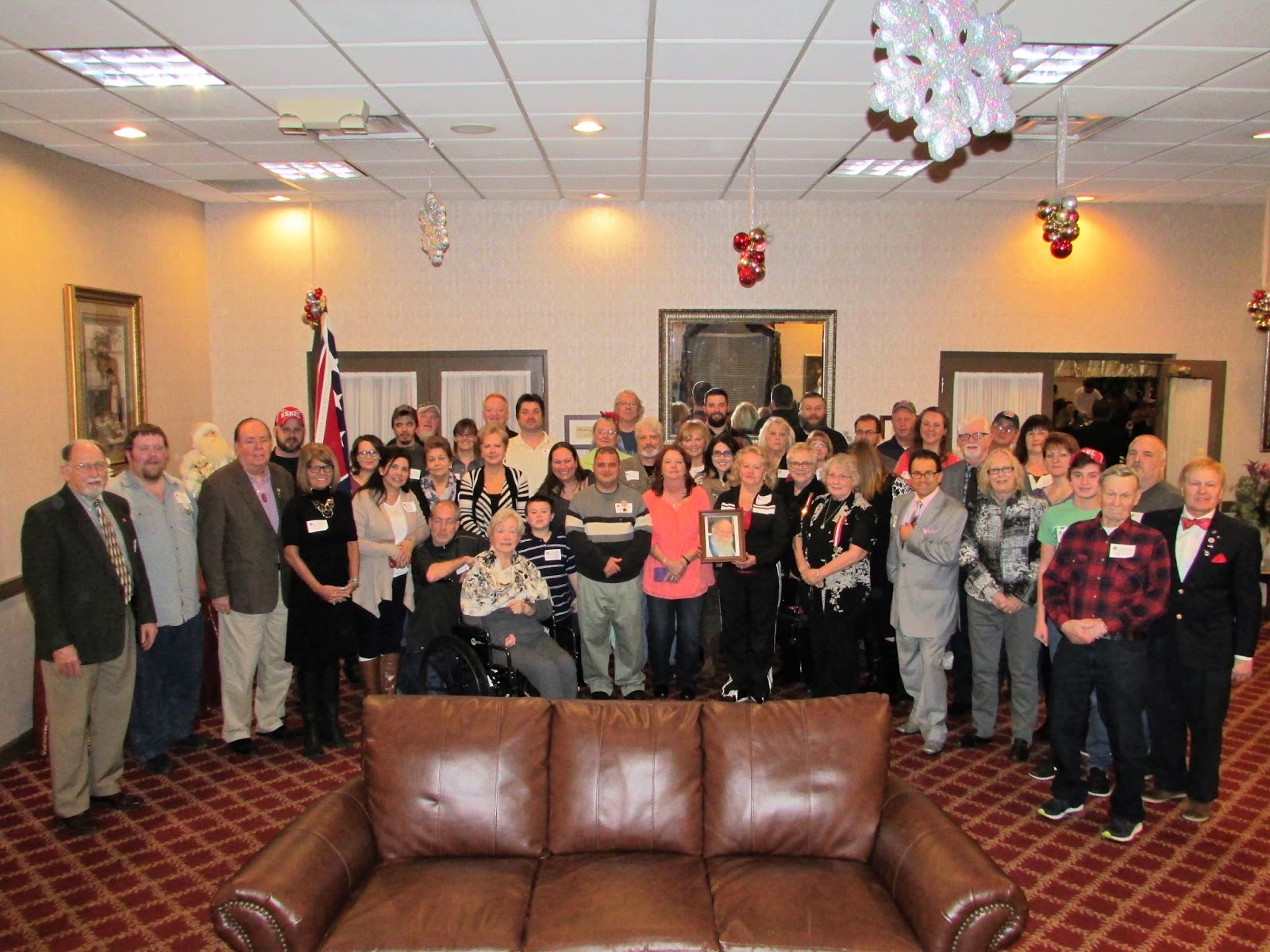
One week later, on January 21st (Stonewall Jackson's birthday), the Admiral Raphael Semmes Camp #1321 hosted it's annual Lee-Jackson Day Dinner at a banquet hall in Milford, MI. While this event is always one of the best attended of the year, this year's attendance was by far the best all-time. Members of SCV Camp #2257, ladies from the Thomas Ryan Chapter #2689 - United Daughters of the Confederacy, plus a number of friends and guests joined the members of the Semmes Camp in honoring these southern heroes.

  Before jumping into the event's festivities, Cmdr. Darron Williams began the ceremonies by honoring the camp's recently departed charter member, Fr. Constantine-Paul Michael Belisarius, with the SCV's memorial rites for a departed compatriot. 

   
Following this solemn ceremony, Cmdr. Williams welcomed all who came out, and kicked things off by showing two special videos - one a music video for "You Ain't Just Whistlin' Dixie" (as performed by the Bellamy Brothers) and another that focused on the truth about slavery. 2nd Lt.Cmdr. Jonathan McCleese was then introduced. At the request of Mrs. Margaret Bigham (from UDC Chapter #2689), a special certificate was presented to honor the Vietnam service of Andrew Keeney, who's wife is a member of the UDC's Thomas Ryan Chapter. Then 2nd Lt.Cmdr. McCleese gave a presentation on the lives of Robert E. Lee & "Stonewall" Jackson.

Throughout the event, a 50/50 raffle and silent auction were held to raise funds for the SCV's Heritage Defense Fund. Thanks to those who donated items for the auction and the generosity of those who participated, the camp was able to raise $508.00, which will assist our organization in paying for the legal battles that arise when the fight to preserve our heritage goes to the courthouse.

For the close of our very special night, we had a new Compatriot, William Maynard, take the oath of membership. Making it all the more special was having his brother, Compatriot Ben Maynard, present him with his certificate of membership.

[Image courtesy of Kirk Chidester]
Robert E. Lee & Stonewall Jackson have long been examples of the best of America. Even in the north, both men were revered and honored by those who fought on the opposite side from them in mortal combat. Today, in our modern culture, society has shifted away from honoring honorable men such as these, but we here in the Michigan Camps of the SCV and many other like minded individuals around our nation still recognize the valuable lessons the memory of these men can still teach... lessons in duty, courage, military service, sacrifice, living moral lives, and commitment to serving God. Let us never forget these two great Southern warriors, and let us always remember to teach other the importance of honoring their memory. Many thanks to everyone who came out to these two special events held in their honor.

To the Memory of Jackson! To the Memory of Lee! To God be the glory! Amen!

Saturday, January 7, 2017

Lee's Old Warhorse: In Memory of Gen. James Longstreet

Welcome, compatriots and friends, to 2017! It my sincere hope that you had the merriest Christmas and the happiest of New Year celebrations! Here at the close of the first week of January, I also hope you have your calendars marked and have made plans to be with us at the Annual Lee-Jackson Day Dinner on January 21st in Milford, MI (additional details should have reached you by email; please, check your inbox for those details).

Earlier this week, on January 2nd, was the 113th anniversary of the passing of Gen. James Longstreet (January 8, 1821 - January 2, 1904), and tomorrow will be the 196th anniversary of his birth. "Pete," as he was affectionately called by his close family & friends, was born in the historic Edgefield District of South Carolina, and, with the encouragement of his father, grew up dreaming of a military career.

In 1838, Pete's dreams came true as he was appointed to the United States Military Academy at West Point. While a cadet he was very popular among his classmates (among them being George Pickett & Ulysses S. Grant) but academically he was not considered impressive, ranking 54th out of 56 cadets when he graduated.

Following his graduation, Longstreet was commissioned a brevet second lieutenant in the 4th U.S. Infantry, and spent his first two years of service at Jefferson Barracks, Missouri. It was there, while serving under regimental commander Lt.Col. John Garland, that he would meet his future wife, Maria Louisa Garland, the daughter of Col. Garland. (Longstreet and Ms. Garland would wed several years later in 1848, shortly after the Mexican-American War.)

In the Mexican-American War (1846-48), Longstreet served with distinction in the 8th U.S. Infantry. Early on in the conflict, he served as a lieutenant under Zachary Taylor's command at the Battle of Monterey, and later received brevet promotions to captain (after the battles at Contreras and Churubusco) and then to major (for his performance in the battle at Molino del Rey). On September 12, 1847, at the Battle of Chapultepec, the young officer was charging up the hill with his regimental colors when he was wounded in the thigh. As he fell, he passed along the flag to his old friend & classmate, George Pickett, who carried the colors up the hill. This was to be Longstreet's final act of gallantry during the Mexican conflict.

After recovering from his wounds & marrying Col. Garland's daughter, Longstreet then took his new bride with him out west, where he would raise his family while serving on frontier duty in Texas, performing scouting missions. He also served as major and paymaster for the 8th U.S. Infantry from July 1858.

When the talks of Southern secession seriously broke out in 1860, Longstreet was not wholly in favor of the option, though he firmly believed in the right of states to do so. Once Southern secession became a reality, he resigned his commission in the U.S. Army and devoted himself to the Confederate Cause. For a look at his Southern war record, I will turn to what was written in Longstreet's obituary, as found in the February 1904 edition of the 'Confederate Veteran' magazine:
"(H)e was immediately appointed brigadier general, and won distinction in the first battle of Bull Run, where he prevented a large force of Federal troops from supporting McDowell's flank attack. On May 5, 1862, he made a brave stand at Williamsburg, where he was attacked by Heintzelman, Hooker, and Karney, and held his ground sturdily until Hancock arrived to reenforce his opponents, when he was driven back.

"At the second battle of Manassas he commanded the first corps of the Army of Northern Virginia, which came promptly to the relief of Jackson when he was hard pressed by Pope's army, and by a determined flank charge decided the fortunes of the day. When Lee retreated to Virginia, after the battle of Gettysburg, Gen. Longstreet, with five brigades, was transferred to Tennessee under Bragg, and at Chickamauga held the left wing of the Confederate forces. He rejoined Lee early in 1864, and was so prominent in the battle of the Wilderness that he was wounded by the fire of his own troops. He was in the surrender at Appomattox on April 9, 1865."
At the Appomattox surrender, as throughout the war, it must have difficult for James Longstreet to be on opposing sides against former West Point classmates such as U.S. Grant. General Lee sought Longstreet's counsel regarding the surrender, and Pete told his superior officer that he thought Grant would be fair in the terms, but as Lee rode out to meet his foe at the McLean House, Longstreet reportedly told him, "General, if he does not give us good terms, come back and let us fight it out."

While some over the years, including some of his prominent peers in the Confederate Army, have criticized Longstreet for his war conduct, many still have honored him for the brave & faithful service he rendered in the struggle for Southern independence. His eulogist in the 'Confederate Veteran' did not hesitate to say that "(t)hroughout the army he was ... considered the hardest fighter in the Confederate service. He had the unbounded confidence of his troops who were ordered to him, and the whole army became imbued with new vigor in the presence of the foe when it became known down the line that "Old Pete" was up."

Most of the harshest criticism of James Longstreet, however, regards his actions and choices after the close of the War Between the States, but the author of his printed eulogy in 'the Veteran' did not use his death as the time to heap scorn upon his memory. Instead, he quoted Gen. Clement Evans (former Confederate general, then commanding officer of the Tennessee Department, United Confederate Veterans) as saying:
"[Longstreet] was one of those who believed that, the South being defeated, there was no need of keeping alive in form even the differences between the sections. Grant was his friend, and I do not believe that when Longstreet was appointed to office in New Orleans the thought of seducing him ever entered the mind of the President, nor did Longstreet regard the appointment [as surveyor of customs in New Orleans] as an attempt to win him over to Republicanism. But as time went on he committed himself beyond recall and there could be no denying the fact that he affiliated with the Republican party, which party he remained in till his death... Now that the old fighter is dead, it is better to forget his mistakes, if he made any, and to remember only the great things of his life, which, indeed, were many, and to honor him for their sake."
James Longstreet died six days before his 83rd birthday in 1904 at the residence of his daughter in Gainesville, GA. His first wife, Louise, and several children preceded him in death. He was survived by his 2nd wife, Helen Dortch, plus 4 sons and a daughter. He was buried next to his first wife at Gainesville's Alta Vista Cemetery.

Per the above advice of General Evans, we remember the great things of Gen. James Longstreet's life and honor him for their sake. Rest well, General.

- Jonathan M. McCleese
2nd Lt. Commander
Admiral Raphael Semmes Camp #1321 (Dearborn, MI)
Army of Tennessee, Sons of Confederate Veterans

Tuesday, November 15, 2016

From Behind Yankee Lines - November 2016

Greetings Compatriots & Friends!

It's been a while since the last update. My Camp Commander instructed me to slow down a bit on the blogging for fear that I might get burned out, but events of the last few weeks have brought forth thoughts and I feel the need to convey them here.

On Sunday, November 6th, I was so blessed with an opportunity to honor our boys in gray, particularly Confederates who suffered and died in Union prison camps, as a part of a Veterans Day Celebration at a church in the suburbs of Detroit. Aside from allowing me to display Camp 1321's battle-flag among their War Between the States artifacts, I was permitted to sing 'The Legend of the Rebel Soldier,' which tells the story of a Southern POW dying in a Northern prison, begging for assurance from the attending chaplain that his soul would be permitted to pass over his beloved Southland before entering into eternal rest. I was nervous, for aside from the fact that I hadn't sang in front of my congregation in more than a decade, I also wasn't certain how such honor for the Confederate soldier would be received so far from Dixie. I was beyond moved at the warm reception and the kind words said afterwards about the tribute given for our brave boys. I sang this song in memory of my two cousins, James & Ananias Moore. A pair of brothers, the Moore boys both served as Privates in the Confederate cause - James with the 31st Virginia Cavalry & "Nias" with the 5th Kentucky Mntd. Infantry. They were both caught and imprisoned at Rock Island, IL, where they would die just two days apart in March of 1864.

Also here in the Great Lakes State, on October 23rd, the Maj.Gen. Patrick Ronayne Cleburne Camp #2257 (Grand Rapids, MI) joined with Robert Finch Camp #14 of the Sons of Union Veterans at Oakwood Cemetery in Traverse City, MI to honor Sgt. David C. Duane of Co. F in the 53rd Virginia Infantry at his gravesite. A nice crowd that included three generations of Sgt. Duane's granddaughters came out on this gorgeous fall day to honor this Southern soldier's memory. Special thanks goes out to SUVCW Camp #14 Commander David Smith for all that he and his men did to make this ceremony happen.

On the flip side, a Traverse City police officer was recently suspended after being caught off duty, in civilian clothing, with a Confederate flag on a personal vehicle, while near a rally against the new President-elect of the United States. (He has since been compelled to resign from his job.) It is the opinion of this author that the flag of our honorable Confederate ancestors should not be used as a modern day political tool by those on either side of the political spectrum; with that said, this is not the first time in recent months that a law enforcement officer in the United States has faced professional repercussions for displaying the Confederate flag in a personal manner, which has nothing to do with the performance of his job. It's a sad state of affairs, here in what is supposed to be "the land of the free," when a person must fear consequences from his employer for what he does when not on official business or on "company time."

This was not the only act of discrimination involving Confederate symbols in the last week following the results of the recent U.S. Presidential election. Rallies protesting the election results occurred in a number of major U.S. cities, including Richmond and New Orleans where Confederate monuments to Lee (in NOLA), Davis & Maury (in Richmond) were vandalized as a result. How ironic that also in protest of the election result several states have seen movements rise up calling for their secession from the Union! While the SCV is a non-political, non-partisan organization, we sometimes find the politics of the modern day and the past intersecting, and I cannot help but recall to memory our great Southern President's prophetic words...
"The principle for which we contend is bound to reassert itself, though it may be at another time and in another form." - Jefferson Davis
Contentious elections, civil unrest drummed up by those who would see us at each others' throats, lies and relentless anti-Southern propaganda... these are all things our ancestors were all too familiar with. Hold fast in the struggle to preserve Southern heritage and honor the brave men of the Confederate armed forces, don't get weary in well doing, and remember that while the darkest hour is just before dawn, we are promised that joy comes in the morning!

DEO VINDICE!
- Jonathan McCleese
2nd Lieutenant Commander
Admiral Raphael Semmes Camp #1321 (Dearborn, MI)
Army of Tennessee, Sons of Confederate Veterans

Wednesday, October 19, 2016

Honor for the Confederacy at the Michigan State Capitol

If I were to ask, I'd venture to guess that very, very few could actually tell me the event of Confederate significance which occurred in Michigan during the fall of 1941. It was, however, on September 20th of that very year when the State of Michigan returned to the Southern states 13 battle flags and three swords, which were taken as spoils of war during The War Between the States more than 75 years earlier.

Taking place on the east steps of the state capitol building, it was described by Maynard Hill in the State Journal newspaper (out of Lansing, MI) as "one of the most colorful open-air ceremonies ever held here (in Michigan)." The event was broadcast nationwide on the radio, and covered by numerous print & photo journalists.

Gen. Julius F. Howell, CiC. of the United Confederate Veterans addresses, with Gov. Van Wagoner of Michigan. [This copy of the original 1941 image is in the Camp #1321 archives, but all rights belong to the photographer and original publisher and it is used under the Fair Use Doctrine.]
Michigan was one of the last of the northern states to return captured Confederate relics. It was through the initiative & efforts of local radio broadcaster Duncan Moore, his radio station (WJR) & the city of Detroit that the legislation was passed in the state congress to make this event happen. Also very influential in making the flag return possible was Mrs. John Bushnell of Detroit; Mrs. Bushnell was a past President of the Robert E. Lee Chapter of the United Daughters of the Confederacy in Detroit, and was also the mother of George Bushnell, a then-current Michigan Supreme Court Justice.

Representatives were sent from 12 of the former Confederate states to receive these southern war-artifacts on behalf of their respective states and the entire south. The representatives were:

TN - Gen. Julius F. Howell, Commander-in-Chief of the United Confederate Veterans
VA - Gov. James H. Price, Governor of the Commonwealth of Virginia
KY - Hon. Rodes K. Meyers, Lt. Governor of Kentucky
TX - Hon. Hatton W. Sumners, U.S. Congressman from Texas' 5th District
AL - Peter A. Brannon, Alabama State Military Archivist
AR - John Pipkin, Arkansas Commissioner of Public Welfare
FL  - Lt.Col. Phillip Stockton May, Florida Governor's Staff
GA - Mrs. Arthur M. Wilson Jr., President of the Atlanta Ladies Memorial Association
LA - Roland Cocreham, Executive Assistant to the Gov. of Louisiana
MS - Dr. W.E. Holcomb, Representative of the Gov. of Mississippi
NC - Dr. C.C. Crittenden, Secretary of the North Carolina Historical Commission
SC - Edward B. Houseal, Representative of the Gov. of South Carolina

Faded & frail, the flags were packaged in gift boxes trimmed with red, white and blue, and the swords were similarly wrapped. Each was presented to the respective Southern representatives by the Governor of Michigan, Murray Delos Van Wagoner. As each presentation was made, the drum and bugle corps of the Morley S. Oates post of the Veterans of Foreign Wars was on hand to punctuate it with a blare of trumpets.

As a military event, this one was particularly unique, with men, both on the speakers' platform and in the audience, wearing military uniforms that spanned more than 75 years of American military history! There were Southern veterans in Confederate gray uniforms, several Union veterans in their blue uniforms, veterans of the (first) World War in their khaki uniforms, a cream-colored uniform worn by a Georgia military aide, and the brand new gray uniform of the then newly formed Michigan state "home defense" troops.

Heading up the delegation of distinguished Southern representatives was the 95-year-old Commander-in-Chief of the United Confederate Veterans, Gen. Julius F. Howell, who was representing the state of Tennessee. Upon receiving a flag and a sword from Michigan's Governor, General Howell thanked the Governor in a clear, firm voice, saying that it was "a most gracious gesture."

The event was tightly scheduled because of time constraints on the radio broadcast, and speakers were asked to make their remarks brief, but when a military aide tried to hurry General Howell, Howell just waved him off (which caused quite a laugh from the crowd) and proceeded to tell stories from his time in the war. Thankfully the radio affiliates were understanding, and respectfully continued their coverage despite going a little over the allotted amount of broadcast time.

In his address, speaking to the Southern delegation collectively, Gov. Van Wagoner said, "I speak for all of Michigan in thanking you for your graciousness in receiving them (the artifacts) in the spirit in which they are given," adding that the relics being given back "have not in a generation been looked upon as trophies. Instead, they have served as reminders of the the glory and the honor that [was] ... [Robert E.] Lee. They have served to remind us of our debt to those who bequeathed us a vast wealth of rich character, and a never-failing source of inspiration. Love and understanding have replaced all bitterness and hate. Mutual respect and fraternal fellowship have come to bless the common purpose of our national endeavor."

Much of the information on this event has been gleaned from the pages of the Winter 1942 edition of the Michigan History Magazine. At the end of the report, the following comments were included by the quarterly publication's editor, George N. Fuller, who wrote:

"We honor these flags, as we honor the brave men who marched beneath them in days that are gone. They are but flags, yet they speak to us of the thousands of boys in Gray, who with faith and hope of youth went into battle for a cause they held dear, the preservation of the ideals and traditions of the Old South. With the eye of fancy, we can see these boys as they stand in line, - as the word is given, see them charge, and form, as the air rings with the storm of battle, some of them never to return to the courageous wives and mothers who sent them away with their blessing. These flags tell of hopes, and of fears, and of prayers for these boys. And now these flags return home, and there they will speak silently to the sons and daughters of the men who bore them, of losses that can never be forgotten..."

[Image from the 1991 50th Anniversary Commemoration of Michigan returning it's Confederate relics.]
Before I close, I would be remiss if I did not mention that this event was remembered on it's 50th anniversary by the Admiral Raphael Semmes Camp #1321 of the Sons of Confederate Veterans with a parade & certificate of appreciation ceremony at the Michigan State Capitol.

DEO VINDICE!
- Jonathan M. McCleese
2nd Lieutenant Commander
Admiral Raphael Semmes Camp #1321 (Dearborn, MI)
Army of Tennessee, Sons of Confederate Veterans
Sources:
[Hill, Maynard. "Return of the Confederate Flags." Michigan History Magazine 1942: 5-23. Print. Volume XXVI, Winter Edition]
[Taishoff, Sol, ed. "Studio Notes." Broadcasting & Broadcast Advertising 6 Oct. 1941: 47. Print.]
[SCV Camp 1321 Archives]

Friday, September 30, 2016

The Jefferson Davis Monument (Monument Ave., Richmond, VA)

[The dedication of the Jefferson Davis Monument; Richmond, VA; June 3, 1907]
 At 2 o'clock in the afternoon on June 3, 1907, before a crowd of thousands of admirers, the Jefferson Davis Monument, on Monument Avenue in Richmond, VA, was unveiled and dedicated to honor the Confederacy's only President on what would have been his 99th birthday.

The event was widely covered in periodical publications of the day, including The Confederate Veteran magazine, which described the scene as "all that could have been imagined. Such a sea of human beings was hardly ever seen in the South... it was a gala day [as] rockets were being sent high above, from which emerged many beautiful figures, conspicuous among which were balloons with magnificent Confederate flags floating, which fell in different parts of the assembly, and a fine band of music and hundreds of girls were singing about the area of the monument. Such a joyous throng of so great magnitude must have rarely ever been witnessed on the earth."

The crowd was extremely large, estimated as being "not less than 125,000" by Lt.Gen. Stephen D. Lee, Commander-in-Chief of the United Confederate Veterans, and that was just the crowd surrounding the Davis monument! Over 1,200 old Confederate veterans & sons are said to have marched down the flag-decorated streets with over 200,000 parade watchers cheering them on.

[Lt.Gen. Stephen D. Lee & others below the soon to be unveiled monument]
One old soldier, bent and weary with age after the parade, told a newspaper reporter, "I was a boy again while the march lasted, but, now that it's over, I'm an old broken man ready to die." He, like so many others, marched like boys again with strength & affection for the Southern Cause, despite the toll that age had taken since the flags were furled at Appomattox.

The speakers stand was filled with dignitaries such as Gen S.D. Lee, Rev J. William Jones, Hon. Claude Swanson - Governor of Virginia, Hon. Carlton McCarthy - Mayor of Richmond, and Maj.Gen. Samuel D. French - the oldest surviving major-general from the Confederate service. Seated on the stage along with these great men was perhaps the most notable gathering of Confederate women ever assembled at an unveiling, including Ms. Mary Custis Lee (daughter of Gen. Robert E. Lee), Mrs. Mary Anna Jackson (widow of "Stonewall" Jackson), and Mrs. Flora Stuart (widow of Gen. J.E.B. Stuart), and others equally worthy of note.

The lady who was given the most attention on this day, however, and rightfully so, was Mrs. Margaret Davis Hayes, the daughter of the late Southern President. It was she, along with two of her children, who had the honored duty of actually making the great unveiling of the Davis monument. When the signal was given, the President's heirs withdrew the veil that covered the statue of the late chieftain! Instantly the guns of the Howitzers boomed out in a Presidential salute, the bands struck up in the playing of 'Dixie,' and deafening cheers & applause erupted from the crowd! For several minutes the air was filled with thunder as fireworks were sent off, celebratory bombs exploded, children sang, and the multitudes roared in excitement as balloons carrying Confederate flags floated overhead.

[The Jefferson Davis Monument; Richmond, VA; July 12, 2016]
After the monument's unveiling, Governor Swanson gave an address to the gathered throngs. I will not reprint it here in full, but in part let me share the following portion of his remarks:
"Sirs, the brave and noble deeds of the Confederate soldiers, extending from the drummer-boy to the great commander - the God-like Lee, constitute for the South her proudest and most precious heritage. We will teach our children's children to cherish the glory, the unsullied honor and the dauntless courage of the Confederate soldier. We purpose that in every county and city of the South some day shall stand a granite or marble column to bear testimony to his heroism and glory." 
[The Jefferson Davis Monument; Richmond, VA; July 12, 2016]
DEO VINDICE!
- Jonathan McCleese
2nd Lieutenant Commander
Admiral Raphael Semmes Camp #1321 (Dearborn, MI)
Army of Tennessee, Sons of Confederate Veterans

Thursday, September 15, 2016

Have You Forgotten...?

This past Sunday, our nation reflected on a dark day in it's history - September 11, 2001 - remembering the nearly 3,000 lives lost 15 years ago when Islamic terrorists hijacked airplanes and rammed them into the World Trade Center towers in New York, the Pentagon in Washington, D.C., and attempted to fly a plane into another target (probably either U.S. Capitol or the White House) before being thwarted by the plane's brave passengers who rammed the plane into the earth to save other lives.

An oft heard question each year around that date is "Have You Forgotten?"

While it is safe to say that no one of a certain age who was living in this country on that dark day has intentionally forgotten what happened, one day that event will become a factoid in a history book and no one who was alive then will still yet inhabit the planet to recall it's horrific events.

Here we are in 2016, more than 150 years after the conclusion of the War Between the States, the costliest conflict in this nation's history in terms of lives lost and blood shed, but I must sadly declare that many Southerners have forgotten not only it's causes and events but also they have forgotten about the lives of their ancestors who were killed for the cause of Southern independence from federal tyranny.

(Image Courtesy of Maeve Magdalen)
Have YOU, personally, forgotten that...
... more than 4,700 Confederate soldiers were killed in the Battle of Gettysburg between July 1-3, 1863?

... more than 2,300 Confederate soldiers were killed in the Battle of Chickamauga between September 19-20, 1863?

... more than 1,700 Confederate soldiers were killed in the Battle of Shiloh in April 1862?

... more than 1,700 Confederate soldiers were killed in the Battle of Franklin on November 30, 1864?

... more than 1,600 Confederate soldiers were killed in the Battle of Chancellorsville in April & May 1863?

... more than 1,500 Confederate soldiers were killed in the Battle of Sharpsburg on Sept. 17, 1862?

... more than 1,500 Confederate soldiers were killed in the Battle of Spotsylvania Court House in May 1864?

... more than 1,400 Confederate soldiers were killed in the Battle of Gaines's Mill on June 27, 1862?

... more than 1,400 Confederate soldiers were killed in the Battle of the Wilderness in May 1864?

... more than 1,200 Confederate soldiers were killed in the Battle of Stones River between Dec. 31, 1862 - Jan. 2, 1863?

... the tens-of-thousands more Confederate soldiers who were killed or wounded at dozens of other battlefields across the South?

... the civilian casualties of Lincoln's war on the South, which are estimated by historians to number into the tens-of-thousands, maybe as high as 50,000+, the vast majority of whom were Southerners?
While it is good and right to remember those victims of terrorism from 9/11/2001, it is despicable that we sons & daughters of Confederate veterans cannot show the same respect & honor to our ancestors, who were no less victims of invasion & terrorism, without being vilified for it! Today it's the memory of our Confederate ancestors which is under attack; in 150 years it might be the memory of you or someone you personally know & love who served in the U.S. military after that dark September day.

We should never forget what happened to our ancestors and to our native Southland in the War of 1861-1865...

WE, THE SONS OF CONFEDERATE VETERANS, WILL NEVER, EVER FORGET!

DEO VINDICE!
Jonathan McCleese
2nd Lieutenant Commander
Admiral Raphael Semmes Camp #1321 (Dearborn, MI)
Army of Tennessee, Sons of Confederate Veterans